 en
en
 WI IT
WI IT
Peated vs Unpeated: The Science of Peat Smoke and Why Some Love It (or Hate It)

There are those who call it “smoky liquid” and those who call it “liquid ash”.
Few topics in the world of whisky divide enthusiasts as much as peat smoke. On one side are the peat fans, ready to swear eternal love to bottles that taste of a lit fireplace, seaweed, smoked bacon and a touch of medicine. On the other, those who, at the first sip of a heavily peated whisky, grimace and declare: “Never again.”
Peated or unpeated? It’s not just a matter of taste: it’s a real sensory challenge that mixes science, Scottish tradition and the reactions of our palate.
But what makes peat smoke so powerful and controversial? Why do some people find it irresistible while others perceive it almost as an assault?
In this article you’ll discover what lies behind that smoky flavour, how the peated character is actually born, what the aromatic differences are between peated and unpeated whiskies and – above all – why your nose and mouth react so differently.
What is peated whisky and what does “unpeated” mean?
To truly understand the difference between a peated whisky and an unpeated one, we need to start from the basics.
Peated (in Italian “torbato” or “smoked with peat”) refers to a whisky whose barley malt has been dried using peat smoke. During this process, the vapours from the burning peat impregnate the malt with aromatic compounds called phenols, which then pass into the distillate and, in part, survive the ageing in cask.
In contrast, an unpeated whisky (non-peated) is produced with malt dried only with hot air, without the use of peat. The result is a “cleaner” whisky, where the natural aromas of the barley, the casks and the terroir emerge without the intervention of smoke.
It’s not therefore two different types of whisky, but a precise choice made during production: the same distillery can produce both more or less peated versions and unpeated ones (think of Bruichladdich, Bunnahabhain, Edradour or many others).
This characteristic strongly defines the style of a distillery. While it’s true that the island of Islay is universally recognised as the historic and undisputed homeland of peated whisky, today peat is no longer an exclusive prerogative of the island: more and more distilleries in other regions of Scotland – such as Ardmore in the Highlands, Balvenie, Edradour or Loch Lomond – produce excellent peated whiskies that are winning over a growing number of enthusiasts.
The tradition of peated whisky actually originated from an ancient necessity: in many areas of Scotland (especially the islands) there wasn’t much wood, but peat was abundant and free. Using it for heating, and… drying the malt, was the most economical and practical solution. Today what was once a simple necessity has become one of the most loved (and debated) characteristics of Scottish whisky.

The science of peat smoke: from field to bottle
To truly understand why a whisky tastes of peat, or smoke if we want to be less technical, we need to follow the entire journey from field to bottle.
It all starts with the peat: a layer of partially decomposed vegetation (heather, mosses, grasses) that has formed in Scotland’s boggy soils for thousands of years. Producers cut it, leave it to dry in the sun and then burn it slowly.
During the malting phase (when the barley germinates and is turned into green malt), this malt is dried in a kiln. Instead of clean hot air, the dense smoke from the burning peat is passed through. Over several hours, up to several days, the vapours impregnate the malt with phenolic compounds (phenols), aromatic molecules that give the typical notes of smoke, medicine, seaweed, creosote and wet earth.
Not all phenols make it into the bottle, however. During distillation many volatilise or transform, and during the long years of cask ageing some soften or integrate with the wood notes. This is why a young, heavily peated whisky can taste “aggressive”, while one aged 12-18 years often becomes more elegant and balanced.
In practice, peat smoke is not an artificially added aroma: it’s a natural imprint left by the terroir and the production method, which makes every peated whisky unique and recognisable from the very first sniff.
PPM: how much smoke is really in your whisky?
If you want to understand “how peated” a whisky is, there is a very useful technical parameter: PPM (Phenol Parts per Million), i.e. the parts per million of phenols present in the malt before distillation.
The higher the PPM value, the more intense the smoky character will be. Of course ageing time also plays its part, as does the type of peat used, but for now let’s keep it simple.
On Whisky Italy we have chosen to classify peated whiskies precisely according to their PPM:
| Peat level | PPM | Typical aromatic profile | Whisky examples |
|---|---|---|---|
| Lightly peated | 1 – 19 ppm | Delicate smoke, light earthy and marine notes | Springbank (~8 ppm), Ardmore (~12-15 ppm), Connemara Peated (~14-15 ppm) |
| Medium peated | 20 – 35 ppm | Evident smoke, iodine, seaweed, medicine, pepper | Highland Park (~20 ppm), Bowmore (~20-25 ppm), Caol Ila (~30-35 ppm), Yoichi (Nikka) (~35 ppm), Bunnahabhain Heavily Peated (~35 ppm) |
| Heavily peated | 36+ ppm | Powerful smoke, ash, creosote, smoked bacon | Laphroaig (~40 ppm), Lagavulin (~40 ppm), Ledaig (~40 ppm), Ardbeg (~55 ppm), Longrow (Springbank) (~55 ppm), Ballechin (Edradour) (50+ ppm), Octomore (Bruichladdich) (100-300+ ppm) |
An important clarification: PPM is measured in the malt, not in the finished whisky. During distillation and especially during cask ageing, a significant part of the phenols is lost or softened. This is why a 35 ppm whisky can taste more “smoky” than a 55 ppm one if the first is young or if the distillery has a cleaner distillation style.
Many enthusiasts think that “higher PPM = better”, but that’s not the case: the balance between smoke, cask sweetness and complexity matters far more than the raw number.
Moreover, not all peat is the same. Islay peat (island peat) is infused with marine influences: seaweed, iodine, salt and sea breeze. The result is a medicinal, briny smoke. The mainland peat of the Highlands is instead more earthy, rich in heather and roots, and gives a woodier, earthier and “sweeter” smoke. This is why an Islay peated whisky (Laphroaig, Ardbeg, Lagavulin) is very different from a Highland peated one like Ardmore or Ballechin.
Peated vs Unpeated: aromatic and taste comparison
Now that we understand how peat smoke is born, let’s see concretely what changes in the glass between a peated whisky and an unpeated one.
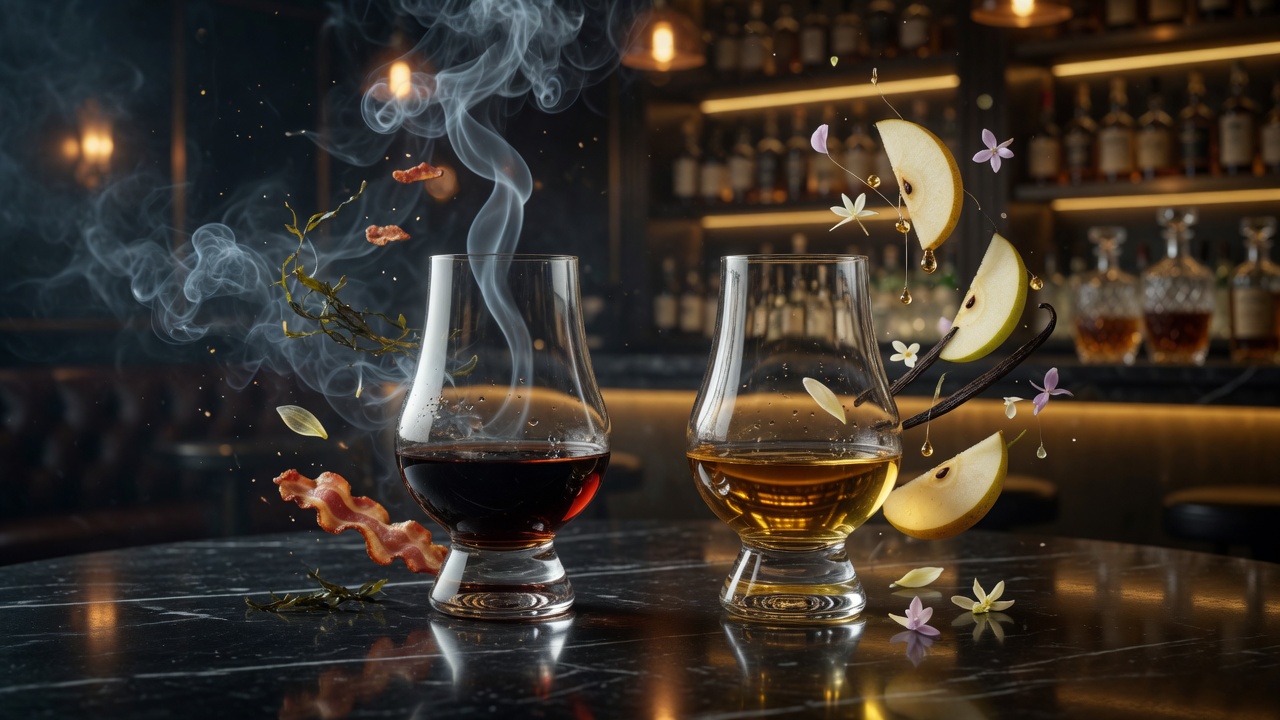
It’s not a clear-cut “this or that” divide. Many peated whiskies have sweet and fruity notes, but the smoke envelops them, integrates them or pushes them into the background. In unpeated whiskies, on the other hand, these notes emerge more cleanly and prominently.
How does the character evolve? A young peated whisky can be very aggressive and “smoky”. With years in cask the smoke softens and leaves more room for sweet and fruity notes (this is the case with many aged Laphroaig, Ardbeg or Octomore). An unpeated whisky gains complexity from the wood but always maintains greater cleanliness and natural sweetness.
This is why many distilleries offer perfect pairs to understand the difference: for example Caol Ila (peated) and the unpeated version of the same distillery, or classic Bunnahabhain vs Bunnahabhain Heavily Peated.
Want to experience the contrast yourself? → Discover our selection of whiskies from the same distillery in peated and unpeated versions here.
Why do some people love it madly? (The psychology of smoke)
There are those who, at the first sip of a Laphroaig or an Ardbeg, smile and say: “Finally home.”
For peat fans, peat smoke is not just an aroma: it’s a strong, almost visceral emotion.
It’s the primal call of fire. It’s the lit fireplace in winter, the barbecue on the beach, the scent of wet wood after the rain. It’s that “smoky umami” character that our brain associates with something deep, ancestral and reassuring.
But it’s not just a matter of olfactory memory. Peated whisky is also a challenge. Those who love it often tell the same story: “The first time I hated it… then it became my favourite.” It’s like going from sugary coffee to black coffee: once the palate gets used to it, there’s no going back. The smoke becomes a warm blanket that envelops everything else, creating a unique sweet-smoky contrast.
And then there’s the community. Peat fans recognise each other. It’s a silent club: just mention Islay, Octomore or “heavy peated” and a knowing smile appears. It’s a taste that divides the whisky world into two teams, and those on the peated side are extremely proud of it.
In short, those who love peated don’t just love a flavour: they love an intense, recognisable experience that leaves its mark. A whisky that doesn’t go unnoticed.
And if you want to experience the difference yourself, discover our selection of peated whiskies classified by peat level here.
Why do many people love unpeated whiskies madly? (The purity of the malt)
There are also those who, at the first sip of an unpeated whisky, smile and think: “Finally I can breathe.”
For many enthusiasts the ideal whisky is clean, elegant and transparent. Without the heavy blanket of peat, the character of the malt, the terroir and the mastery of the casks can express themselves to the fullest.
Unpeated whiskies offer a different experience: notes of ripe fruit, honey, vanilla, flowers, sweet cereals and soft spices emerge clear and defined, without having to fight against the smoke. It’s like listening to a track without distortion: every nuance is heard perfectly.
Many love them because they find them more refined and drinkable. They don’t assault you, they conquer you slowly with harmony and depth. They are whiskies you can sip for a long time without getting tired, perfect for a quiet evening, for meditating or to accompany a meal. They don’t leave you with a mouth full of ash, but with a soft and persistent warmth.
It’s the realm of the great Speyside distilleries, of many elegant Highland whiskies, of the Lowlands and of many Japanese whiskies. Here the real protagonist is the distillate itself: the barley, the water, the wood of the casks. No extreme character is needed to be complex.
For these enthusiasts, peated whisky is often too intrusive, almost a distraction from the true spirit of whisky. They seek purity, balance and finesse rather than intensity.
How to choose between peated and unpeated
There is no whisky that is “better” in absolute terms. There is only the one you like.
The choice between peated and unpeated is a matter of personal taste and the type of sensory experience you are looking for in the glass.
Choose a peated whisky if…
- You love intense, bold flavours with strong character
- You like the smoky peat notes of fireplace, bacon, creosote and especially the marine, salty, iodine and seaweed ones (typical of many Islay whiskies)
- You are looking for a whisky with strong personality that leaves a clear and memorable imprint
- You appreciate intensity and contrasts between smoke and other notes (sweet, fruity or salty)
Choose an unpeated whisky if…
- You prefer cleaner, more elegant and precise flavours
- You want to clearly taste notes of ripe fruit, honey, vanilla, flowers, cereals and soft spices
- You are looking for a more refined, harmonious and less aggressive whisky on the palate
- You love subtle complexity and a smoother, more relaxed experience
Practical tips for choosing well
- If you are a beginner, start with a lightly peated whisky (Springbank, Ardmore, Connemara) or a classic clean unpeated one.
- To really understand the difference, try the same distillery in both versions whenever possible (e.g. classic Bunnahabhain vs Bunnahabhain Heavily Peated).
- You don’t have to choose just one team: many enthusiasts (including us) happily drink both styles depending on mood, season or occasion.
In the end the only rule that matters is one: taste, experiment and trust your nose and your palate.
Conclusion – Peated or unpeated: there is no wrong choice
Peated or unpeated?
There is no right or wrong choice.
Some seek the intensity and wild character of smoke, while others prefer the cleanliness, elegance and purity of the malt. Both styles have their charm and are part of the great whisky tradition.
And which side are you on?
Write in the comments: are you Team Peated or Team Unpeated? What is your favourite whisky?
And if you want to experience the difference yourself, discover our selection of peated and unpeated whiskies here.
Whisky is meant to be tasted, not just read about. Which bottle shall we open first?